
Harvard Cybersecurity Course 2026 | No Fee + Free Certificate
Harvard Cybersecurity Course 2026 | No Fee + Free Certificate

Harvard Cybersecurity Course 2026 | No Fee + Free Certificate
The Harvard Cybersecurity Course 2026 offers an exceptional opportunity for individuals seeking to enhance their knowledge and skills in the field of cybersecurity. This comprehensive program, designed by leading experts at Harvard University, provides participants with cutting-edge insights into the latest cybersecurity trends, threats, and defense mechanisms. Remarkably, the course is offered at no cost, making it accessible to a wide audience eager to delve into the complexities of digital security. Upon successful completion, participants are awarded a free certificate, validating their expertise and commitment to cybersecurity excellence. This initiative underscores Harvard’s dedication to fostering a secure digital future by equipping learners with the necessary tools to protect and defend against cyber threats.
Overview Of Harvard’s Free Cybersecurity Course 2026
In an era where digital threats are increasingly sophisticated and pervasive, the demand for skilled cybersecurity professionals has never been higher. Recognizing this critical need, Harvard University has launched its Cybersecurity Course 2026, a groundbreaking initiative designed to equip individuals with the essential skills and knowledge required to navigate the complex landscape of cybersecurity. What sets this course apart is its accessibility; it is offered at no cost and includes a free certificate upon completion, making it an invaluable opportunity for aspiring cybersecurity experts worldwide.
The course is meticulously structured to provide a comprehensive understanding of cybersecurity principles, practices, and technologies. It begins with foundational concepts, ensuring that participants, regardless of their prior experience, can grasp the essential elements of cybersecurity. This includes an introduction to the types of cyber threats, such as malware, phishing, and ransomware, and the strategies employed to mitigate these risks. As the course progresses, learners delve deeper into more advanced topics, such as network security, cryptography, and ethical hacking, providing a well-rounded education that covers both theoretical and practical aspects of the field.
One of the distinguishing features of Harvard’s Cybersecurity Course 2026 is its emphasis on real-world application. Participants are not only exposed to theoretical knowledge but are also given the opportunity to engage in hands-on exercises and simulations. These practical components are designed to mirror real-life scenarios, allowing learners to apply their knowledge in a controlled environment. This experiential learning approach ensures that participants are not only able to understand cybersecurity concepts but are also capable of implementing them effectively in real-world situations.
Moreover, the course is delivered by a team of esteemed faculty members and industry experts, ensuring that participants receive instruction from some of the leading minds in the field. These instructors bring a wealth of experience and insight, offering learners the opportunity to gain a deeper understanding of the current trends and challenges in cybersecurity. Additionally, the course includes guest lectures from prominent figures in the industry, providing participants with diverse perspectives and the latest insights into emerging threats and technologies.
Another significant advantage of this course is its flexibility. Recognizing the diverse needs and schedules of its participants, Harvard has designed the course to be accessible online, allowing learners to progress at their own pace. This flexibility ensures that individuals from various backgrounds and time zones can participate without the constraints of a traditional classroom setting. Furthermore, the course materials are available on-demand, enabling participants to revisit and review content as needed, reinforcing their learning and understanding.
Upon successful completion of the course, participants receive a certificate from Harvard University, a credential that holds significant value in the professional world. This certificate not only serves as a testament to the participant’s knowledge and skills but also enhances their employability in a competitive job market. As organizations across the globe continue to prioritize cybersecurity, having a certification from a prestigious institution like Harvard can be a decisive factor in career advancement.
In conclusion, Harvard’s Cybersecurity Course 2026 represents a remarkable opportunity for individuals seeking to enhance their cybersecurity expertise. By offering this course at no cost and providing a free certificate, Harvard is making a significant contribution to the development of a skilled cybersecurity workforce. Through its comprehensive curriculum, practical application, expert instruction, and flexible delivery, the course equips participants with the tools they need to succeed in the ever-evolving field of cybersecurity.
Key Benefits Of Enrolling In Harvard’s Cybersecurity Course
Enrolling in Harvard’s Cybersecurity Course in 2026 offers a multitude of benefits that extend beyond the allure of a prestigious institution. One of the most compelling aspects of this course is its accessibility, as it is offered at no cost and includes a free certificate upon completion. This initiative reflects Harvard’s commitment to democratizing education and making high-quality learning opportunities available to a broader audience. By removing financial barriers, the course opens doors for individuals from diverse backgrounds to gain critical skills in a field that is increasingly vital in today’s digital age.
The curriculum is meticulously designed to provide a comprehensive understanding of cybersecurity principles and practices. Participants will delve into topics such as network security, cryptography, risk management, and ethical hacking. This breadth of content ensures that learners acquire a well-rounded knowledge base, equipping them with the tools necessary to tackle real-world cybersecurity challenges. Moreover, the course is structured to cater to both beginners and those with some prior experience, making it an inclusive learning environment that fosters growth and development for all participants.
In addition to the robust curriculum, the course is taught by esteemed faculty members who are experts in the field of cybersecurity. Their extensive experience and insights provide learners with a unique opportunity to gain knowledge from leading professionals. This interaction not only enhances the learning experience but also allows participants to engage with cutting-edge research and emerging trends in cybersecurity. Furthermore, the course includes guest lectures from industry leaders, offering students a glimpse into the practical applications of their studies and the current landscape of cybersecurity.
Another significant benefit of enrolling in this course is the emphasis on hands-on learning. Through practical exercises and real-world simulations, participants can apply theoretical concepts to realistic scenarios. This experiential approach not only reinforces learning but also builds confidence in handling cybersecurity issues. By engaging in these activities, learners develop critical thinking and problem-solving skills that are essential for success in the cybersecurity field.
Networking opportunities are another advantage of participating in Harvard’s Cybersecurity Course. Students will have the chance to connect with peers from around the globe, fostering a diverse and dynamic learning community. These connections can lead to collaborative projects, professional relationships, and even career opportunities. Additionally, the course’s online format allows for flexible learning, enabling participants to balance their studies with personal and professional commitments.
Upon completion of the course, participants receive a certificate from Harvard, a credential that holds significant value in the job market. This certification not only validates the skills and knowledge acquired but also enhances the learner’s professional profile. In an era where cybersecurity expertise is in high demand, having a certificate from a renowned institution like Harvard can be a distinguishing factor in career advancement.
In conclusion, enrolling in Harvard’s Cybersecurity Course in 2026 offers numerous benefits that extend beyond the acquisition of knowledge. The course’s accessibility, expert instruction, hands-on learning approach, and networking opportunities make it an invaluable experience for anyone looking to enhance their cybersecurity skills. With the added advantage of a free certificate, participants are well-equipped to navigate the complexities of the cybersecurity landscape and pursue successful careers in this critical field.
How To Register For Harvard’s No-Fee Cybersecurity Course
In an era where digital threats are increasingly sophisticated, the demand for cybersecurity expertise has never been higher. Recognizing this need, Harvard University has launched an innovative initiative: a no-fee cybersecurity course that offers a free certificate upon completion. This course is designed to equip participants with essential skills to navigate the complex landscape of cybersecurity. For those interested in enhancing their knowledge without financial burden, understanding the registration process is crucial.
To begin with, prospective students should visit the official Harvard University online learning platform. This platform serves as the gateway to a plethora of courses, including the highly sought-after cybersecurity program. Once on the website, users should navigate to the course catalog, where they can search specifically for the cybersecurity course. It is advisable to use keywords such as “cybersecurity” or “free certificate” to streamline the search process. Upon locating the course, users will find a detailed description outlining the curriculum, learning objectives, and the skills they will acquire.
The next step involves creating an account on the platform. This process is straightforward and requires basic personal information such as name, email address, and a secure password. It is important to ensure that the email address provided is active, as it will be used for all course-related communications. After successfully creating an account, users should log in to access the course registration page. Here, they will find an option to enroll in the course. By clicking on the enrollment button, users will be prompted to confirm their registration.
Once enrolled, participants will receive a confirmation email containing important details about the course schedule and access to course materials. It is essential to review this email carefully, as it will also include instructions on how to access the online learning environment. The course is designed to be flexible, allowing participants to learn at their own pace. This flexibility is particularly beneficial for individuals balancing other commitments alongside their educational pursuits.
Throughout the course, participants will engage with a variety of learning materials, including video lectures, interactive modules, and practical exercises. These resources are curated by leading experts in the field, ensuring that learners receive a comprehensive education in cybersecurity. Additionally, the course includes assessments to evaluate understanding and reinforce key concepts. Successfully completing these assessments is a prerequisite for obtaining the free certificate.
Moreover, participants are encouraged to take advantage of the discussion forums and networking opportunities available within the course platform. Engaging with peers and instructors can enhance the learning experience and provide valuable insights into real-world cybersecurity challenges. As the course progresses, participants will build a robust foundation in cybersecurity principles, preparing them for further study or career advancement in this critical field.
In conclusion, registering for Harvard’s no-fee cybersecurity course is a straightforward process that opens doors to invaluable knowledge and skills. By following the outlined steps, prospective students can seamlessly enroll and embark on a journey toward cybersecurity proficiency. This initiative not only democratizes access to high-quality education but also empowers individuals to contribute to a safer digital world.

What To Expect From Harvard’s Cybersecurity Course Curriculum
Harvard University’s Cybersecurity Course 2026 offers an unparalleled opportunity for individuals seeking to enhance their understanding of cybersecurity without the burden of financial constraints. This course, which is offered at no cost and includes a free certificate upon completion, is designed to provide participants with a comprehensive understanding of the critical aspects of cybersecurity. As the digital landscape continues to evolve, the importance of cybersecurity has never been more pronounced. Consequently, Harvard’s curriculum is meticulously crafted to address the multifaceted challenges and opportunities within this dynamic field.
The course begins with an introduction to the fundamental principles of cybersecurity, ensuring that all participants, regardless of their prior knowledge, have a solid foundation. This initial phase covers essential topics such as the history of cybersecurity, key terminology, and the basic concepts that underpin the field. By establishing a strong groundwork, the course ensures that participants are well-prepared to delve into more complex topics.
Following the introductory phase, the curriculum transitions into a detailed exploration of network security. This section emphasizes the importance of protecting data as it travels across networks, a critical component of any cybersecurity strategy. Participants will learn about various network security protocols, firewalls, and intrusion detection systems. Through practical exercises and real-world case studies, they will gain hands-on experience in identifying and mitigating network vulnerabilities.
As the course progresses, attention shifts to the realm of cryptography. This segment is crucial for understanding how data can be securely transmitted and stored. Participants will explore different encryption techniques, including symmetric and asymmetric encryption, and learn how these methods are applied in real-world scenarios. The curriculum also covers the role of cryptography in ensuring data integrity and authenticity, which are vital for maintaining trust in digital communications.
In addition to technical skills, the course places a strong emphasis on the human element of cybersecurity. Participants will examine the psychological and social factors that contribute to cyber threats, such as social engineering and phishing attacks. By understanding the motivations and tactics of cybercriminals, participants will be better equipped to develop strategies that address these human-centric vulnerabilities.
The curriculum also includes a comprehensive overview of cybersecurity policies and regulations. As governments and organizations worldwide implement stricter cybersecurity measures, understanding the legal and ethical implications of cybersecurity practices is essential. Participants will study key legislation and standards, such as the General Data Protection Regulation (GDPR) and the National Institute of Standards and Technology (NIST) framework, gaining insights into how these regulations impact cybersecurity strategies.
To ensure that participants are prepared for the ever-changing landscape of cybersecurity, the course concludes with a focus on emerging trends and technologies. Topics such as artificial intelligence, machine learning, and blockchain are explored, highlighting their potential to both enhance and challenge existing cybersecurity measures. By staying informed about these advancements, participants will be well-positioned to anticipate and respond to future cybersecurity challenges.
In summary, Harvard’s Cybersecurity Course 2026 offers a comprehensive and accessible curriculum that equips participants with the knowledge and skills necessary to navigate the complex world of cybersecurity. Through a blend of theoretical knowledge and practical application, the course prepares individuals to protect digital assets effectively and contribute to the broader effort of securing our increasingly interconnected world.
Success Stories From Harvard’s Cybersecurity Course Alumni
The Harvard Cybersecurity Course has become a beacon of opportunity for individuals seeking to enhance their skills in the ever-evolving field of cybersecurity. With the introduction of the 2026 edition, which offers no fee and a free certificate upon completion, the course has attracted a diverse group of participants from around the globe. The success stories of alumni from previous cohorts provide a compelling testament to the course’s impact on their professional journeys.
One notable success story is that of Maria Chen, a software engineer from Singapore. Before enrolling in the Harvard Cybersecurity Course, Maria had a foundational understanding of cybersecurity but lacked the advanced skills needed to tackle complex security challenges. The course’s comprehensive curriculum, which covers topics ranging from network security to ethical hacking, equipped her with the knowledge and confidence to transition into a cybersecurity analyst role at a leading tech firm. Maria credits the course’s hands-on labs and real-world case studies for her ability to apply theoretical concepts to practical scenarios, ultimately leading to her career advancement.
Similarly, John Thompson, a mid-career IT professional from Canada, found the course to be a pivotal turning point. Despite having years of experience in IT, John recognized the growing importance of cybersecurity in his field and sought to upskill. The Harvard Cybersecurity Course provided him with a structured learning path and access to industry experts who offered invaluable insights. As a result, John was able to implement robust security measures within his organization, significantly reducing the risk of cyber threats. His newfound expertise also opened doors to speaking engagements at cybersecurity conferences, further establishing him as a thought leader in the industry.
Moreover, the course has been instrumental for individuals like Aisha Khan, a recent college graduate from India, who was eager to enter the cybersecurity workforce. With limited professional experience, Aisha faced challenges in securing a job in the competitive cybersecurity market. However, the Harvard Cybersecurity Course not only enhanced her technical skills but also provided her with a prestigious credential that set her apart from other candidates. The course’s emphasis on collaboration and networking allowed Aisha to connect with peers and mentors, ultimately leading to a job offer from a multinational corporation.
In addition to individual career advancements, the course has fostered a sense of community among its alumni. Graduates often collaborate on projects, share job opportunities, and continue to support each other’s professional growth long after completing the course. This network of cybersecurity professionals has become a valuable resource for alumni as they navigate the challenges and opportunities within the field.
The success stories of Harvard Cybersecurity Course alumni underscore the transformative power of accessible education. By removing financial barriers and offering a free certificate, the 2026 edition of the course democratizes access to high-quality cybersecurity training. As the demand for skilled cybersecurity professionals continues to rise, the course’s alumni are well-positioned to make significant contributions to their organizations and the broader cybersecurity landscape. Their achievements serve as an inspiration to current and future participants, highlighting the potential for personal and professional growth through this esteemed program.
Harvard Cybersecurity Course 2026 | No Fee + Free Certificate details :
Get a Free CS50 Certificate from Harvard. A CS50 Certificate is a free certificate from CS50 itself. Apply for the Harvard Cybersecurity Course 2026. This course comes with No Fees, and applicants will be eligible to receive a Free certificate if they submit and receive a score of at least 70% on each of this course’s problems as well as its final project. The course is open to anyone; even if you are not a student at Harvard, you are welcome to take this course for free. More details are below.
Quick Details
- Course Mode: Online
- Platform: OpenCourseWare
- Certificate: Yes (Free)
- Deadline: 31st December 2026
Overview of the Harvard Cybersecurity Course
In this course, you will learn:
- Learn how to secure your accounts, data, systems, and software against today’s threats and how to recognize and evaluate tomorrow’s as well, both at home and at work.
- Learn how to preserve your own privacy.
- Learn to view cybersecurity not in absolute terms but relative, a function of risks and rewards (for an adversary) and costs and benefits (for you).
- Learn to recognize cybersecurity as a trade-off with usability itself.
- The course presents both high-level and low-level examples of threats, providing students with all they need to know technically to understand both. Assignments inspired by real-world events.
How to take this Course?
Even if you are not a student at Harvard, you are welcome to take this course for free via this OpenCourseWare by working your way through the course’s five weeks of material.
Obtaining Your Free Certificate
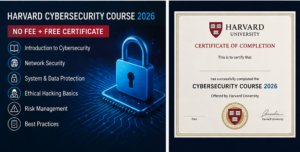
Once you have completed the course and met all of the requirements, you’ll see a link on your Gradebook page allowing you to request a free CS50 Certificate, much like the one shown here. This link will be available within approximately four hours after you receive your score for your last required assignment and your progress bar in your Gradebook indicates course completion.
What name will appear on my certificate?
Free certificates will include the name you provide when you claim your certificate. You will personally type the name you wish to appear on your certificate during the redemption process.
How to Enroll in the Course?
Please read the FAQs and learn how to enroll in the course. The link is below.
APPLY NOW FOR THE HARVARD CYBERSECURITY COURSE